Fathers, Widows and the Rise of European Women's Capital.

Europe now counts 146 women billionaires with a combined net worth of $784.5bn — twice as many as ten years ago. Yet the path to that wealth is remarkably narrow: three in four inherited it from their father, and fewer than one in ten runs the business that carries her name.
These are the headline findings of Women Billionaires — Wealth Report 2026 No. 1, the institute's first structural study of Europe's women billionaires, sponsored by Vanessium. Built on the Forbes Billionaires lists for 2016 and 2026, it codes every woman on two questions: where her wealth came from, and how actively she takes part in the business that holds it today.
146 women, 17 countries, $784.5bn
The 2026 universe covers 146 named women across 17 European countries, every one with a valued net worth. Their average age is 60.6, ranging from 26 to 91. Almost half — 48.6% — entered the Forbes list in 2020 or later, as inheritances crystallised and valuations rose through the pandemic years and a wave of listings.
At the top sits Françoise Bettencourt Meyers of France, at $100bn, followed by Rafaela Aponte-Diamant ($44.5bn), co-founder of the shipping line MSC, and Susanne Klatten of Germany ($29.7bn).
| # | Name | Worth | From | Role |
|---|---|---|---|---|
| 1 | Françoise Bettencourt Meyers, France | $100bn | Mother | Family office |
| 2 | Rafaela Aponte-Diamant, Switzerland | $44.5bn | Co-founded | Family office |
| 3 | Susanne Klatten, Germany | $29.7bn | Father | Board |
| 4 | Vicky Safra, Greece | $27.1bn | Husband | Family office |
| 5 | Renata Kellnerová, Czech Republic | $20.2bn | Husband | Board |
| 6 | Beate Heister, Germany | $19.1bn | Father | Board |
| 7 | Charlene de Carvalho-Heineken, Netherlands | $17.9bn | Father | Board |
| 8 | Antonia Ax:son Johnson, Sweden | $14.8bn | Father | Board |
| 9 | Sandra Ortega Mera, Spain | $13.2bn | Mother | Family office |
| 10 | Francine von Finck, Germany | $12.3bn | Husband | Passive |
Fathers first
The single most important fact about women's wealth in Europe is where it starts. 110 of the 146 women — 75.3% — inherited their fortune from their father. This is not a national quirk: it is the dominant pattern in every country in the dataset.
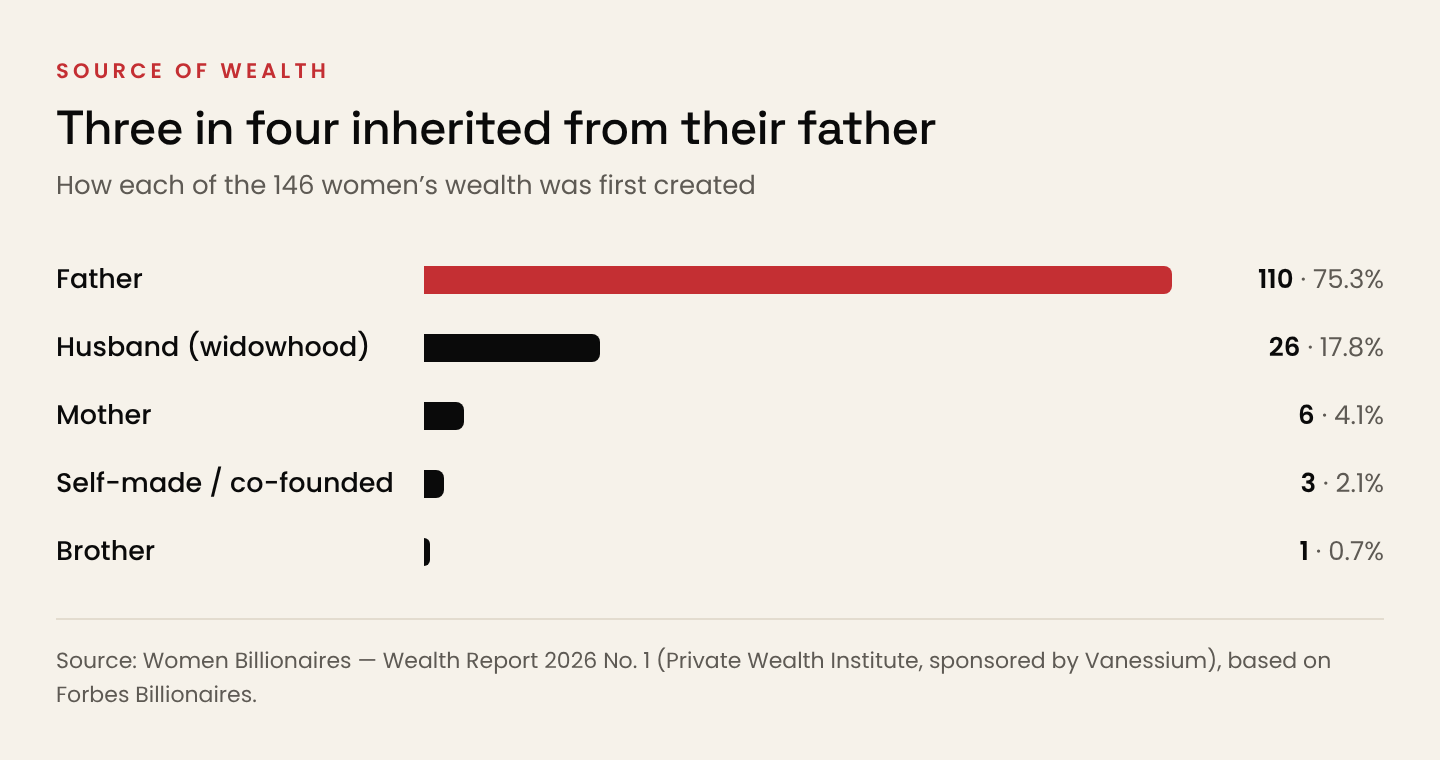
The second path runs through marriage. 26 women (17.8%) hold wealth that came from a husband — and almost always through widowhood, not divorce. The report tracked this distinction deliberately: the typical case is the widow of a self-made man who built an industrial or financial group. Six women inherited from their mother, and one from a brother.
The self-made exception
Only three of the 146 built their wealth themselves — rare enough to name individually:
- Rafaela Aponte-Diamant (Switzerland, $44.5bn) co-founded MSC with her husband in 1970; it is now the world's largest container shipping line.
- Denise Coates (United Kingdom, $8.1bn) founded the online betting operator Bet365 and built it from scratch.
- J.K. Rowling (United Kingdom, $1.2bn) turned a single manuscript into a literary and licensing empire.
A board seat — or no seat at all
The second question is how involved each woman is in the business today. Here the picture splits in two. 55 women (37.7%) sit on the board of directors, while 53 (36.3%) are passive shareholders with no role in decisions. Together these two poles cover almost three-quarters of the universe.
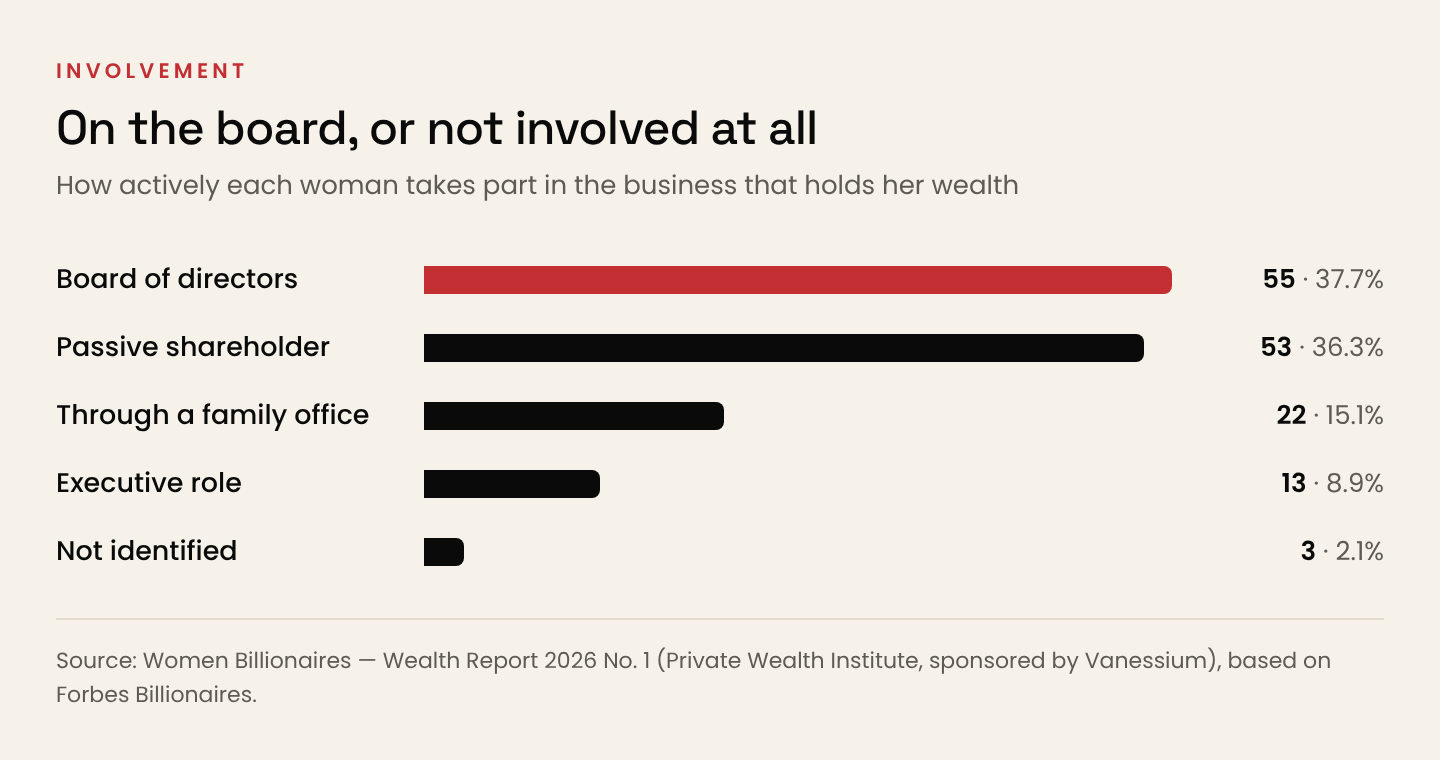
The middle ground is thin. 22 women (15.1%) take part through a family office or foundation rather than the operating company, and only 13 (8.9%) hold an executive role and run the business day to day.
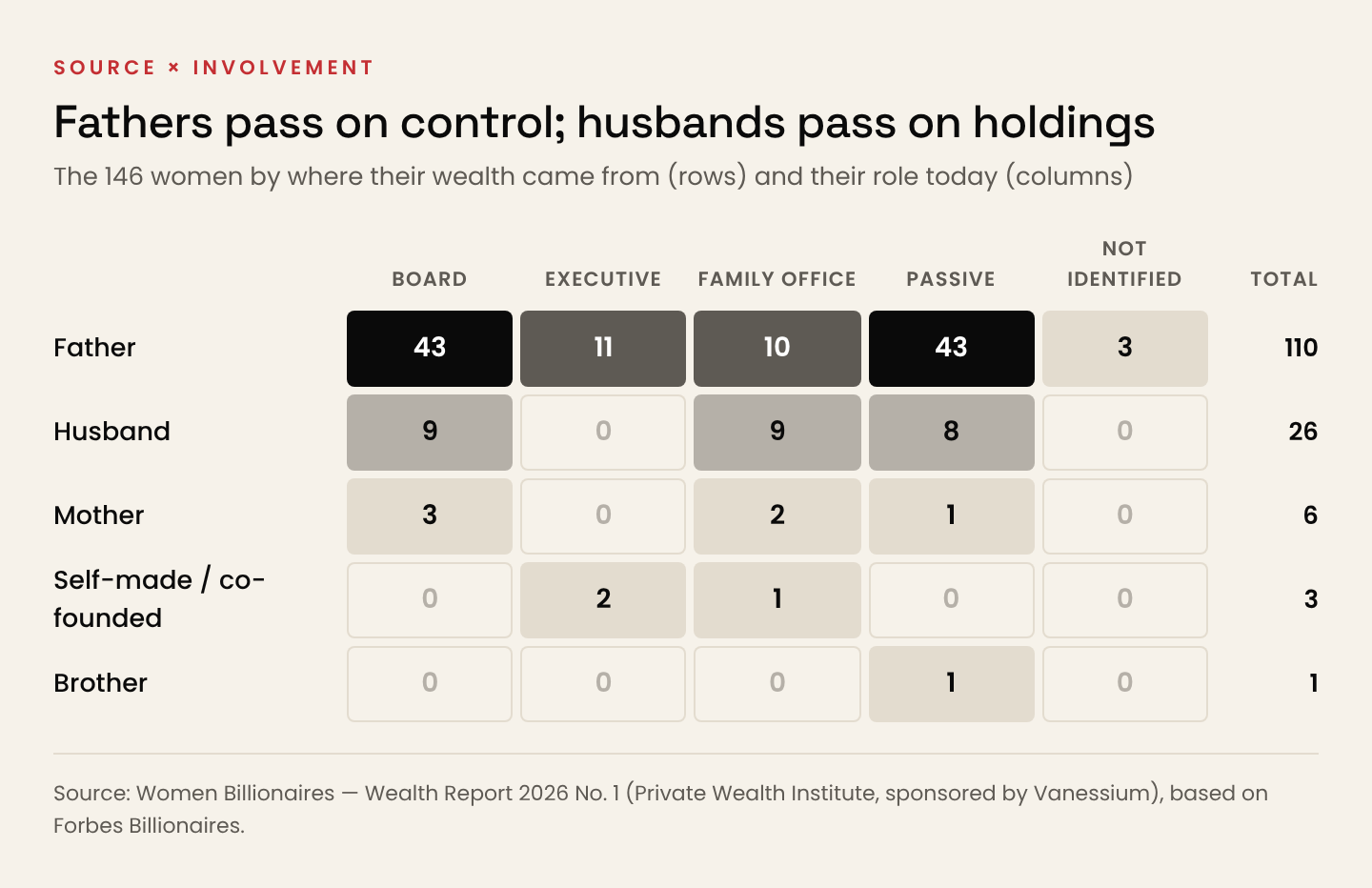
Read together, the two questions tell a clear story. Operational control is passed from father to daughter far more often than any other way: 11 of the 13 women in executive roles inherited from their father. Wealth that arrives through a husband takes a different shape — no widow in the dataset holds an executive role, and around a third (9 of 26) manage their stake through a family office.
Germany's Mittelstand effect
Geography is just as concentrated. Germany alone accounts for 57 of the 146 women — 39% of the total. The reason is structural: the density of private, family-owned industrial companies, the Mittelstand, produces dynasties with several heirs in each generation.
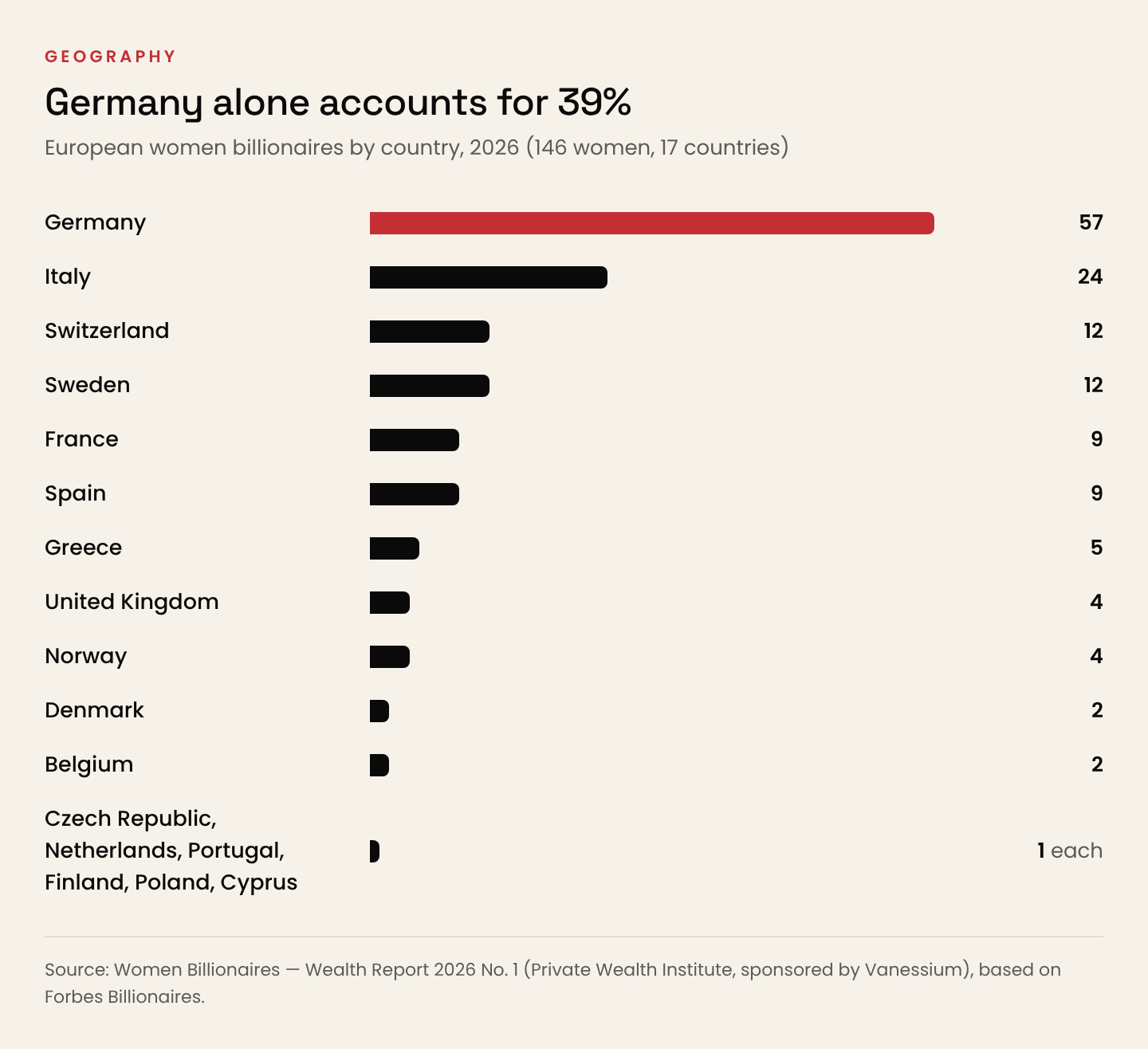
Southern Europe — Italy, Spain and Greece — adds 38 women, led by Italy's 24. Switzerland and Sweden follow with 12 each, reflecting Switzerland's concentration of private wealth and Sweden's position as the Nordics' largest cluster.
A decade of growth
Over ten years, the number of European women billionaires has doubled, from 73 in 2016 to 146 in 2026. That is faster than Europe's billionaire population as a whole, which grew 1.71 times, from 401 to 686.
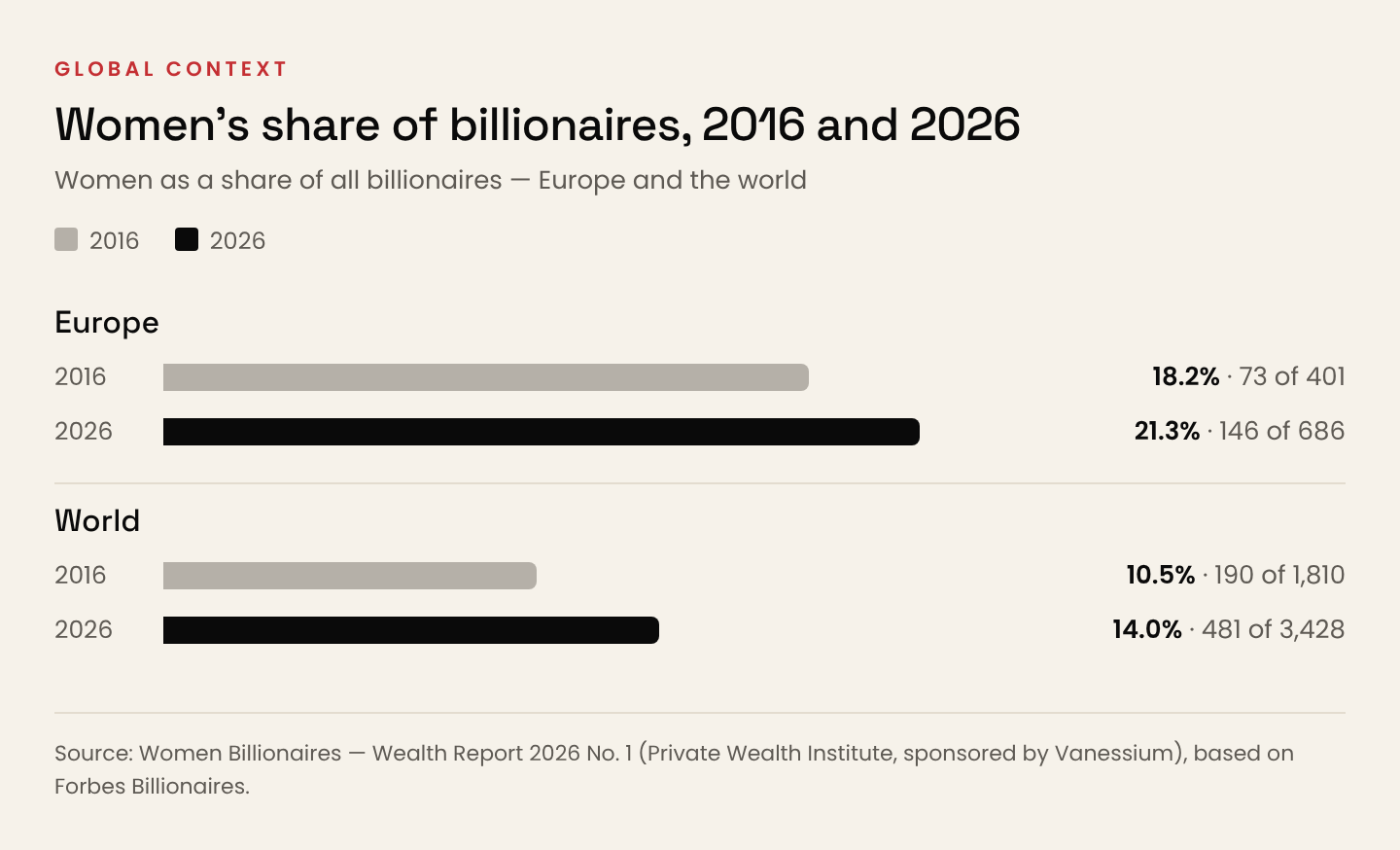
As a result, women's share of Europe's billionaires rose from 18.2% to 21.3% — a structural gain, not only a rise in headcount. Europe remains well ahead of the world, where women make up 14.0% of billionaires. But the gap is narrowing: worldwide, the number of women billionaires grew 2.53 times over the decade (from 190 to 481), against Europe's 2.0 times.
What it means for owners and families
Three conclusions stand out. First, European women's capital is overwhelmingly inherited capital, and it is handed down by fathers — which places succession planning, not entrepreneurship, at the centre of how women come to hold large fortunes. Second, inheriting ownership rarely means inheriting the business itself: most heiresses either govern from the board or stay entirely passive. Third, the speed of change is real. With nearly half of today's women billionaires appearing on the list since 2020, the next decade of intergenerational transfer is likely to reshape the picture again.
About the report
Women Billionaires — Wealth Report 2026 No. 1: Fathers, Widows, and the Rise of European Women's Capital was produced by the Private Wealth Institute and sponsored by Vanessium. It covers the full Forbes 2026 European universe of 146 named women, each coded by source of wealth (father, husband, mother, sibling, self-made or co-founded) and by involvement in the business (executive, board, family office, passive or unknown), and sets the results against the 2016 lists.
Download the full report (PDF, 16 pages) — including the directory of all 146 women, ordered by net worth.
For questions about the data, or to discuss the report, write to info@privatewealth.institute.